
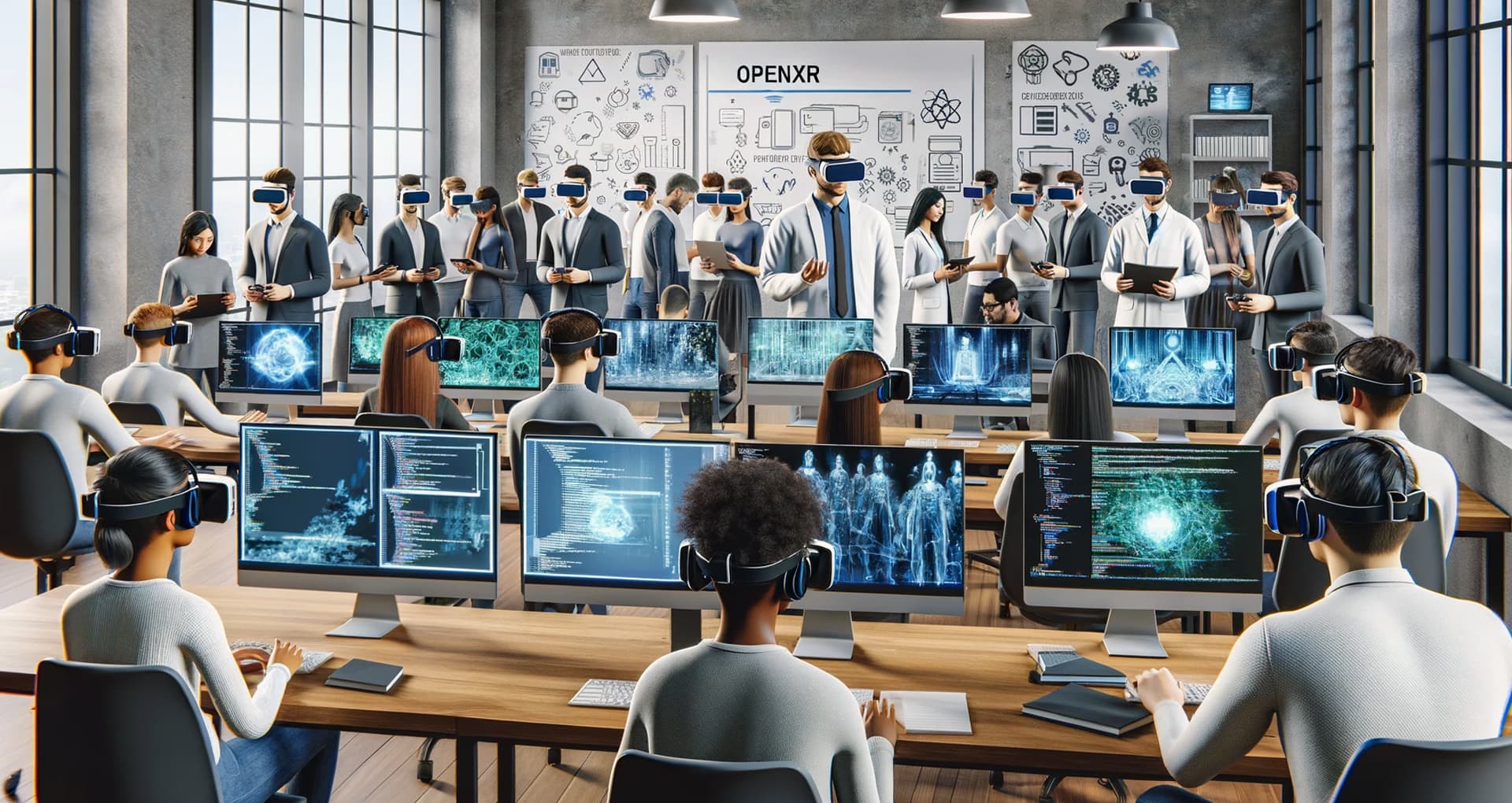
Higher Education with OpenXR: The Future of Virtual Reality on Campus
Revolutionizing Higher Education with OpenXR: The Future of Virtual Reality on Campus In the contemporary landscape of higher education...
Revolutionizing Higher Education with OpenXR: The Future of Virtual Reality on Campus
In the contemporary landscape of higher education, universities are constantly exploring innovative technologies to enhance teaching and learning experiences. Virtual reality (VR) has emerged as a transformative tool, offering immersive environments that can significantly enrich educational outcomes. However, the deployment of VR in universities has faced challenges due to the fragmentation of VR platforms, each requiring specific software and hardware configurations. OpenXR, an open, royalty-free standard developed by the Khronos Group, addresses these challenges by enabling seamless VR application development across diverse devices, revolutionizing how VR is integrated into higher education.
The Role of OpenXR in Higher Education
OpenXR provides a unified interface for VR hardware and software, facilitating the creation of applications that are compatible across multiple VR systems. This standardization is particularly beneficial for universities, which often have diverse technological ecosystems. By adopting OpenXR, universities can make VR technology more accessible to students and faculty, regardless of the VR devices available on campus.
Enhancing Academic and Research Opportunities
Reducing Costs and Simplifying IT Management
The adoption of OpenXR can lead to significant cost savings for educational institutions. Universities can invest in the VR hardware that best suits their budget and needs without being locked into a specific platform, allowing for more sustainable long-term investments in VR technology. Additionally, IT departments benefit from simplified management of VR applications and hardware, as OpenXR’s compatibility reduces the need for multiple versions of the same educational content.
Preparing Students for the Future Workforce
Incorporating VR into university curricula not only enhances educational outcomes but also prepares students for the future workforce. Proficiency in VR technology, facilitated by OpenXR’s widespread adoption, can give students a competitive edge in industries where VR is becoming increasingly prevalent, such as healthcare, architecture, and entertainment.
Supporting Innovative Teaching
For educators, OpenXR provides tools to create more dynamic and engaging lesson plans. Whether it's simulating historical events, visualizing mathematical concepts, or exploring scientific phenomena, teachers can leverage VR to deliver content in ways that are not possible with traditional methods. This engagement can lead to greater student interest and enthusiasm for subjects, potentially improving academic performance.
As VR continues to grow as a pivotal educational tool, OpenXR stands out as a crucial development for its potential to democratize access to VR technologies in higher education. By providing a standardized platform that bridges the gap between various VR devices and software, OpenXR is set to significantly enhance the educational landscape of universities. Institutions adopting OpenXR will not only provide their students with cutting-edge tools but also position themselves at the forefront of educational innovation, ready to embrace the technological advancements that VR brings to the academic world. With its promise of compatibility, reduced costs, and enhanced learning experiences, OpenXR is indeed shaping the future of virtual reality in universities.
Author: Gerald Ferreira
Exploring the frontiers of immersive technology, delivering expert insights into VR, AR, and the digital future of South Africa.